What is Yeaft?
Yeaft Web Code Agent is a browser control plane for code agents that execute on your connected machines. It combines vendor CLI conversations with Yeaft's native multi-provider engine instead of forcing every workflow through one provider or one runtime.
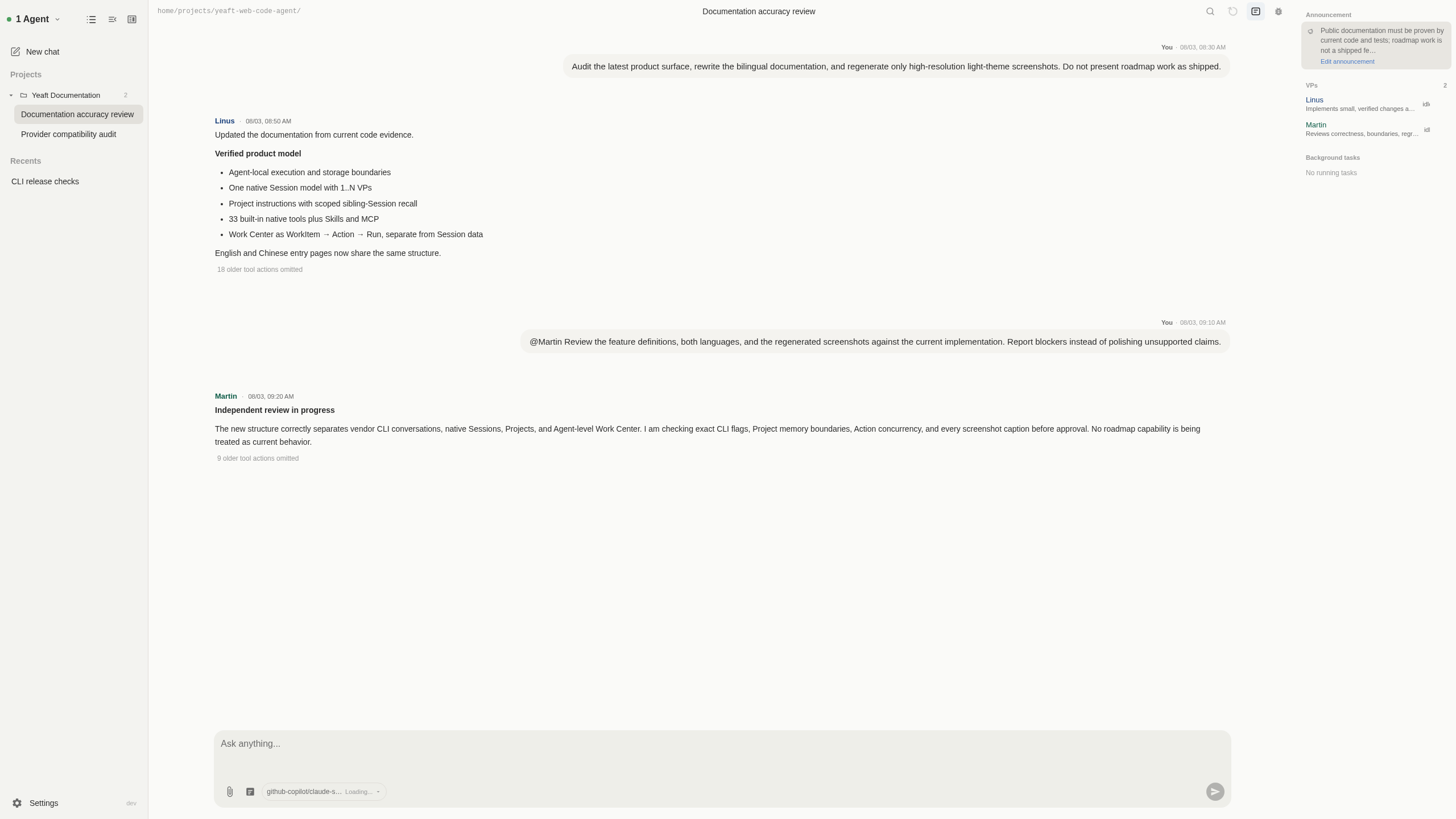
The system in five objects
| Object | Responsibility |
|---|---|
| Agent | Runs on the machine that owns the code. It executes tools, starts optional CLI providers, calls native LLM providers, and stores Agent-local Yeaft data. |
| Session | The native engine's durable conversation unit. A Session has 1..N VPs, one timeline, a working directory, model settings, announcement, and scoped memory. |
| VP | A reusable Virtual Person with a persona, localized role metadata, traits, and a primary/fast model hint. |
| Project | Groups native Sessions and supplies a shared instruction. Related Sessions on the same Agent can recall scoped summaries without merging their transcripts. |
| WorkItem | A persistent Work Center goal that is planned into Actions and executed as fenced Runs. It is Agent-level and can outlive the source Session turn. |
A one-VP Session is the normal focused coding-assistant shape. Adding VPs does not switch to a different mode; it only gives the same Session more roles to address in parallel.
Choose an execution path
| Path | Use it when | Runtime boundary |
|---|---|---|
| Claude Code | You want Claude Code's exact tools, skills, MCP behavior, compact/clear commands, and resume model | A locally installed Claude Code CLI process per conversation |
| GitHub Copilot | You want Copilot entitlement, ACP permission prompts, and Copilot's model catalog | A locally installed copilot --acp process per conversation |
| Yeaft Code Agent | You want provider-neutral native execution, 1..N VPs, scoped memory, Projects, 33 tools, or Work Center handoff | The native engine inside yeaft-agent; no vendor CLI subprocess |
The three paths share navigation and rendering where their event models overlap, but their provider-specific commands and persistence semantics remain explicit. See Choose a code agent path.
Native Session collaboration
A Yeaft Session can:
- route one user turn to a default VP or to several
@mentionedVPs; - show each VP's streamed response and tool evidence in the shared timeline;
- use explicit
RouteForwardhandoffs between current Session members; - run background shell jobs and sub-agents with durable status records;
- search and page persisted history;
- inspect model routing, token usage, tool calls, and stop reasons;
- create a persistent WorkItem when work should continue beyond the interactive turn.
Projects add organization and controlled context sharing. A Project instruction is injected into each member Session, but sibling Session transcripts and legacy summaries are not automatically recalled or injected.
Durable work with Work Center
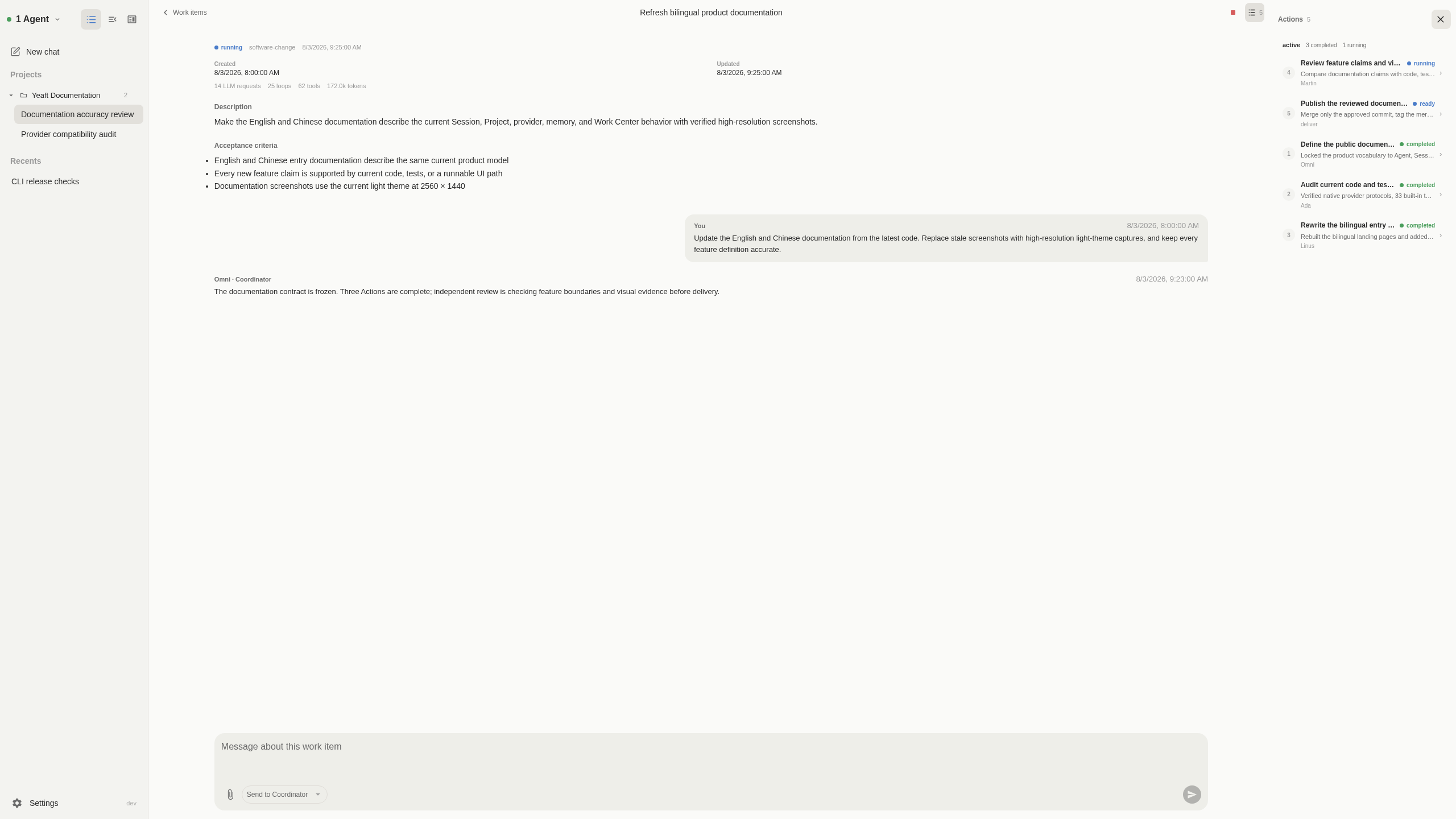
Work Center is an Agent-level task system, not a second conversation mode. A WorkItem stores a goal, acceptance criteria, working directory, attachments, and its own Coordinator conversation. AI triage can produce a validated Action graph; the scheduler assigns eligible VPs and executes ready Actions up to the configured concurrency limit.
Current Work Center behavior includes:
- dependency-checked Action graphs with a unique final acceptance gate;
- auto, pool, or fixed VP assignment and optional role separation for review;
- per-Action model/effort policies and explicit workspace policies;
- shared, read-only, isolated-write, and integration execution paths;
- waiting, retryable, failed, cancelled, and completed outcomes;
- human guidance to the Coordinator or a specific Action;
- persisted Run identity, usage, messages, tool evidence, and restart recovery.
A WorkItem is linked to its origin Session, but its lifecycle and SQLite data belong to the Agent's Work Center.
Providers, tools, and memory
The native LLM layer supports Anthropic Messages and OpenAI Responses protocols. Providers may use static API keys or supported dynamic credentials such as GitHub Copilot, and each model can override protocol and limits.
The built-in native registry currently contains 33 tools covering files, patches, shell/background tasks, Git worktrees, search, Web access, images, notebooks, planning, WorkItem creation, and agent/VP orchestration. Skills and MCP servers may add more tools, so the effective list depends on the Agent and Session policy.
Dream/H2-AMS is retired from the active runtime. Native turns use a bounded window of the current Session’s persisted history; they do not recall or inject legacy memory or sibling Session summaries. Existing memory files are retained on the Agent, and post-turn compact remains a separate history-window feature.
Browser workspace
Beyond the native engine, the Web application provides:
- a unified, Agent-aware Session catalog with Project and Recents sections;
- terminal, Git status/diff, file browser/editor, and port proxy;
- up to three side-by-side Claude Code/Copilot conversation panes;
- an Expert Panel for Claude Code conversations;
- Work Center board, WorkItem conversation, Action inspection, and retained execution evidence;
- English/Chinese localization and light/dark themes;
- authentication, optional TOTP/email verification, per-user Agent secrets, and administration views.
Ownership and security boundary
Code execution and native Yeaft runtime data stay on the Agent. The central server authenticates users, stores browser-facing account/catalog metadata, and relays owner-checked WebSocket traffic. A Session workDir selects the project execution context; it does not own Session transcripts, memory, tasks, or Work Center data.
Raw tool output, debug traces, attachments, model credentials, and local project files are sensitive. See Security before exposing a deployment beyond a trusted network.